
Something to Lose
They found something better than force to control us

“Direct contact with and knowledge of the planet has been snapped. Disconnected, like astronauts floating in space, we cannot know up from down or truth from fiction. Conditions are appropriate for the implementation of arbitrary realities.”
Former top-tier advertising executive Jerry Mander said that about the television in his 1978 book Four Arguments for the Elimination of Television.
1978 feels like a long time ago, because it was. Anyone, including Mander, worried about television back then would be baffled about the current state of things. A wireless telephone turned out to be the bigger problem. There’s always a new problem, or opportunity, depending on how you see it.
People watched TV back then unaware of its effect. Wise mothers called it, “the idiot box” and warned it could melt your brain. None of that dimmed desire for more programming. They even called it programming, the executives curating images to hook viewers.
The stronger the hook, the higher the advertising rates charged to corporations. Mander and other ambitious ad execs used this addictive tech to sell more of whatever product had the biggest marketing budget.
Loss of Senses
It all seems so innocent now…since the telephone took over as the most addictive way to stumble through life.
Television required a living room, basement, or at least a beanbag. The phone has people walking into poles and missing almost everything happening around them.
In Four Arguments, Mander goes to great lengths to warn humanity about the dangers of TV. It’s not just the messaging; the actual device is the root of the danger.
TV has a hypnotic effect. People sort of can’t look away, can’t get up, or can’t retract the recliner footrest. The eye stops noticing other inputs, mutes its own incredible ability, since it’s not needed while staring at a screen.
The eye might be the most incredible part of the human body. It takes in a vast array of information, tone, contrast, piping all of that directly to the brain. Causing instant reactions in the nervous system.
We form deep and immediate feelings about things we see. Yet we chose to eagerly hand over complete control of that powerful organ to a wood-paneled box in the living room.
There’s a sensory deprivation element to TV watching. The viewer starts to lose awareness. That means loss of judgment. Willingness to take information as true, complete, trustworthy, and more valuable than seeing it for yourself.
It’s not the same as a photograph, which surely seemed dangerous long ago. Mander notes Native groups who forbid photographs because the photo viewer likely has no context to properly take in the picture. Pretty smart…
Mass Confusion
You don’t need to buy Mander’s book… or any book mentioned in TTL.
The purpose of a good newsletter used to be a look at the editor’s way of seeing things. Some different view which might help boost the odds you find traction on your path.
That’s long gone. Newsletters generally are little more than marketing traps these days. The money is just too good. Get you into a funnel, let you stumble from click to click just sure there’ll be some real good tip. Then rent out your email address like tenement housing.
We link to the books mentioned here as a courtesy. Also, so you know it’s real, not more made-up marketing trash.
The same goes for Infinite Jest, my favorite book. Just because we share a link to it, doesn’t mean you should buy it. Further, you don’t need to start reading it, stop reading it, then send an email about how it makes no sense and you’re irritated you bought it. Nobody told you to buy it…
Try to see how this connects to what Mander so passionately wrote about in his book. How being trapped in an endless funnel of online clicking leads to the opposite of success in the modern era.
The 92nd Street YMCA in the Upper East Side offered a panel discussion on my favorite book in Q1. The author died by felo de se so it’s fun to hear people who worked with him closely talk about him. He was weird by your standards. Iconic by mine.
One former student mentioned the Mander book as a key influence for Wallace. Infinite Jest is at its core a satirical commentary on how we consume entertainment. And what that says about us. That’s it… Yes, the book is a ~1,100-page fractal of a fictional story, void of a typical structure you look for in a book.
But Wallace had a sort of fascination with television, how it consumed the viewer, led to near total submission of will. This is a key part of his seminal work.
Thinking about that interests me. Reading Mander’s 48-year-old book for insight into Wallace’s motivation helps me process what I see happening around me today.
Softer Force
Good fiction makes you think… Good thinking helps you de-personalize what you see.
Mander was a little bit of a hypocrite. A Wall Street Journal reporter profiled his daytime success charging automobile companies for expert ad services, contrasted with his moonlight work advising environmental groups.
His book reads like part apology, part ideological crusade. Also, political. He seems outright pissed that Nixon lost to Kennedy in 1960 when Kennedy mastered television appeal. Then Nixon hired a bunch of strategists to curate his television appearance. Obviously…
The wheel keeps turning. People get knocked off their horse. They spend the rest of their lives warning of equine perils. They do this for unrelated reasons. It’s why they miss the big picture. It’s wise to ignore all of that. Like most things in life, take what works, discard the rest. Don’t personalize it.
If you can’t do that, you’ll miss big changes. You’ll stay stuck in your own view while things evolve right in front of you.
As the points he stayed hung up on evolved, Mander didn’t live long enough to see a new product peddled to the masses. More of an idea than a product. Wealth.
Capitalism in the 20th century was all about scarcity. Cities like Miami and New York were beyond dangerous. Physically dangerous. Needle Park, the gang wars at Miami shopping malls, it was crazy.
These days, people behave like they have something to lose. They’re in a sort of money hypnosis where everyone believes they might get rich. Like an ongoing national sweepstakes. Fear of missing out keeps them believing in the possibility of success. That keeps them generally in line.
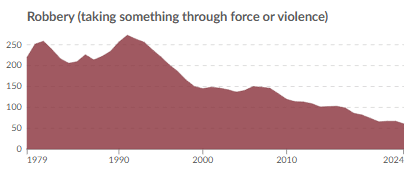
You’ll see scary news headlines about this or that incident. But the fact is, we face lower rates of violent crime today than at any point since Mander’s book.
This obsession with getting more in a daily sweepstakes runs all the way up the food chain. Take my word for it. People with ~$500 million net worth still dig, claw, risk, and lunge for more. (After $1 billion you switch to worrying what your peers think of you)
Nobody knows what more is, but they need to get it. There’s nothing wrong with that. More is more fun, if you know how to spend it. Most people don’t.
The valuable takeaway in all this isn’t moral. It’s seeing the orderly mob of speculators for what they are. That makes it easier to predict what they’ll do next.
Charging Ahead to Nowhere
There’s a huge movement online around “Cracking the $100k barrier.”
This means catapulting to $100k any way possible. Message board forums become a community where people racing toward this arbitrary marker encourage each other to take as much risk as possible. They offer comfort to those bruised and battered in the process.
Wealthy people know you rarely catapult anywhere. Sometimes you’ll end up with a 10-bagger, or better, but it’s always an accident. More evidence that luck shines on good thinking. Nobody in the $100k chase has time for that.
It’s why they do jobs they hate for money they’ll lose speculating. This trend leads to gigantic moves in stocks otherwise stuck in the gutter. Like the ~800% surge and crash in Avis Budget Group Inc (CAR) earlier this year.
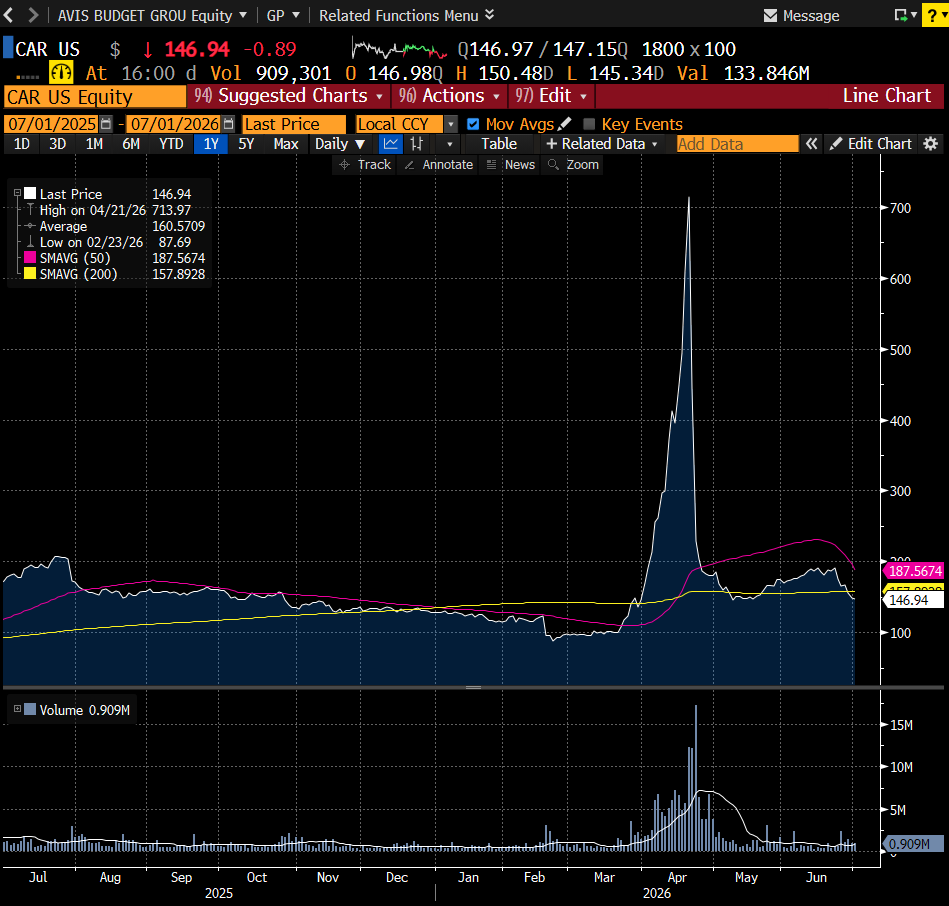
The rallying cry is always, “Save this company!” without any knowledge of what that means. Also, without any awareness of the disaffected mob driving it.
The mob has no idea it’s a mob. Each participant feels autonomous, yet joins the group chasing an idea they collectively buy into. Instead of finding something to do they enjoy, and letting the magic of life work, they feel on the outside of a life they can’t access.
Surely there’s a digital loop feeding this. Images of watches, cars, lifestyles they crave yet imagine exist by some form of unfair access for others. They think the way to get it is obsessive pursuit of things.
When the rallying cry changed to “SAVE WENDY’S” they charge that way leaving the rental car company behind. Never mind the details of the situation.
Yes, Wendy’s, home of the Frosty, Baconator, and never-frozen beef patties. Billionaire Nelson Peltz sunk his canines into the burger chain in the ~90s. He has the board packed with loyalists, including one of his eight kids. He’s pulled untold benefits out of Wendy’s over ~30 years. Fees, perks, scale, serious heft. That’s his baby.
Slim chances the $100k mob outfoxes his plans to smash the chain like a burger patty then take it private.
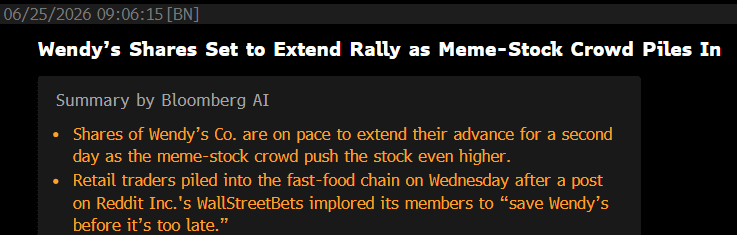
This is what many people call investing today. They’re part of a hypnotized mob charging around a market they don’t understand.
That doesn’t mean return to value stocks, or some ridiculous over-correction. It means seeing the mob for what it is. That makes predicting what it does next easier.
Missing The Point
The problem with the mob is it never makes progress. ~50% profit in a whole year isn’t enough when you need to turn $500 into $100k ASAP.
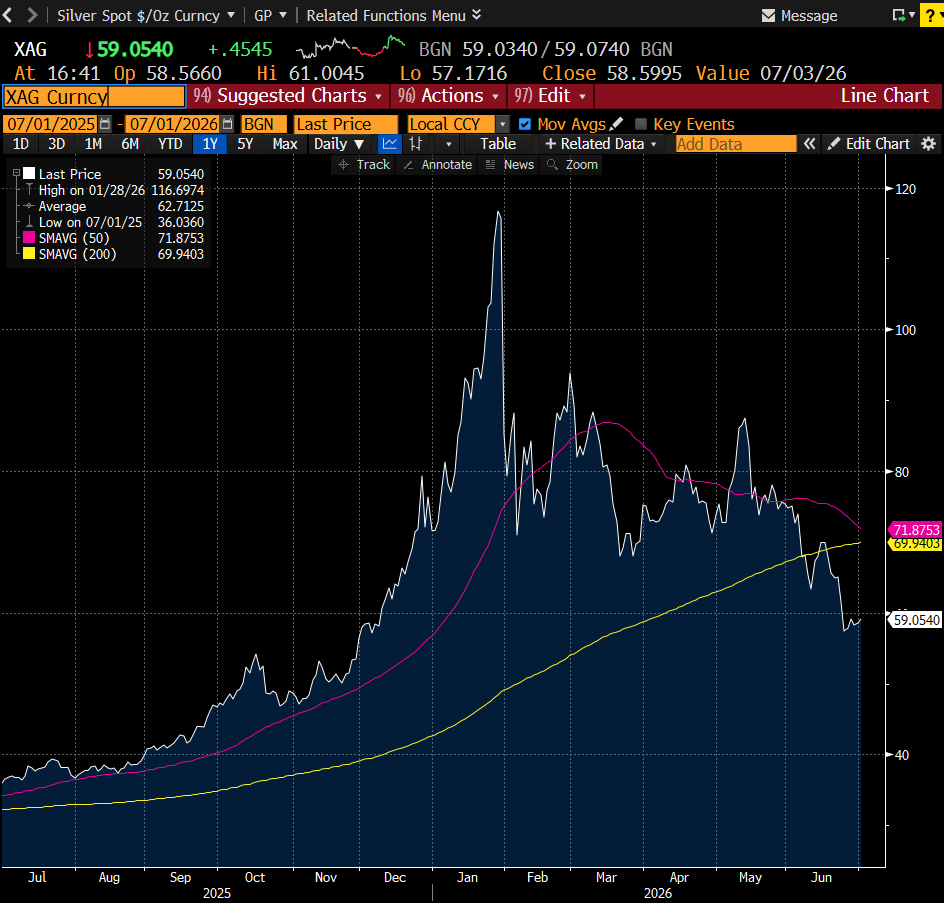
Take the Q1 rise in silver for instance. The mob got very excited about that, at the highs.
Meanwhile, TTL published this on January 1. Don’t bother reading it now, it’s too late.
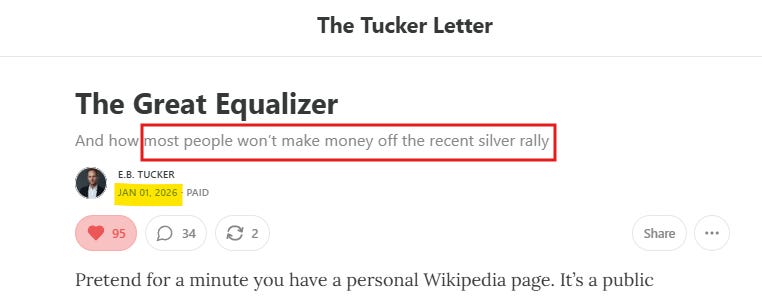
This is not a told-ya-so newsletter. Far from it. We sat here at TTL HQ telling you that the silver rise seemed insane. Not once, several times.
Then, we told you how trying to sell silver proved difficult, which seemed like evidence we should try to actually sell some. And we did.
The first lot went off at $121/oz which felt scary. You try selling physical bars to a an eager mob and tell me you’re not afraid you’ll see $150/oz the next day. That’s real.
Further, TTL is not a perfect letter. Meaning, there is no pre-instructed way to act. It’s all feel.
We ended up selling about ~10% of the Tucker silver hoard over ~$100/oz. That did pay for most of the entire hoard since silver was up over ~10x from the price paid.
Had we known the gut feeling was this accurate, we would’ve sold it all.
It’s not that there’s anything wrong with having some silver. The issue is, people get downright religious about it. It’s weird.
This is a commodity with extreme leverage moving the price around. The physical market has little to do with the price. It’s why there are guys shopping for Porsches after that fall in half from ~$120… Porsches with all the options. Like the ones you have to crate up and ship in the belly of an Airbus A380.
Sure, we cashed several 5-figure checks on those Q1 sales. They were actually checks since the only way to sell proved to be local shops on consignment at a fee of $3/oz. Mail-in brokers wouldn’t touch it due to the extreme daily moves.
You move along making the best decision you can. Perfection is elusive. We trimmed the silver, that’s better than the $100k chasers likely did.
Lost and Alone
Here’s a novel idea for the $100k chasers… start acting like the person you want to be.
Leave Wendy’s to Nelson Peltz. There are better burgers out there, Peltz sort of ruined Wendy’s before the era of smash burgers.
If you go to New York this summer, try George Motz’s Hamburger America. It’s worth the line.
I saw Motz in the Atlanta airport recently, and did not approach, because I appreciate being left alone, and figure maybe he does too. But the man makes about the most classic burger available. Ultra simple, and worth going out of your way.
Motz spent years roaming the country with a camcorder trying to find the best burger, study the history of burgers, and admits to eating an estimated ~50,000 burgers.
He didn’t do stunts like posting TikToks about eating gross burgers for likes and views. Partly because they didn’t have TikTok ~20 years ago. Also, because he’s the real deal. He’s nerdy in a way I respect.
Get into something. If you want to be successful, put the screen down and go pursue something you think is cool.
People just can’t do it. Mostly for the reasons Mander laid out 48 years ago. They’ve submitted to machine-control. The machine just sells you things you don’t need.
The television is almost a museum piece now; most sensible people threw it out years ago. The Tucker kids have never seen one on the wall of the Florida house, or the New York pad.
Mom’s cul-de-sac palace is a different story… which might be a good thing. In my opinion, diverse environments create more awareness than one controlled setting.
Let them eat nuggets at a friend’s birthday party… shred up the iPads next door, and let them hunt for the words to describe the setting when asked about it later. It’s good for them. They’ll face much worse later. The ability to think is their only hope.
Flowing Along With Change
You, on the other hand, face a much more difficult task. The phone is a blackhole to the unaware user. The supermom with a silicone finger holder accessory carrying the phone like it’s an oxygen tank.
The chance of success while fully submitted to external control is low. Sure, you can blame people for your circumstances, the rest of the mob will comfort you, but you’ll never make it anywhere worth going.
And it’s not about the actual phone, that’ll one day seem as benign as the wood-paneled television.
We’ll soon have computerized glasses. Talk about further torture for the optical nerve, flooding it with a constant tidal wave of stimuli. Then we’ll have immersive experience pods people lie in like coffins. Eventually, brain implants. The means and methods change with the times.
If you want real revenge, learn how to use each invention for your advantage. Use it to boost your cognitive capacity, and never submit it to any external authority.
The Real Revenge
Before we get into the portfolio review let’s be clear on one thing. There’s nothing wrong with walking into a pole if you’re staring at a handheld phone watching professional tennis.
This week it’s full speed ahead at the grass major, Wimbledon, which we wrote about last week. The British hosts put on a good time and stick you with the bill. Typical experience you’d expect there which is cultural, all the way up to the monarch who needs £99 million to cover expenses.
At least some of that goes to the rising price of cybersecurity… which we aim to catch a piece of in the portfolio.
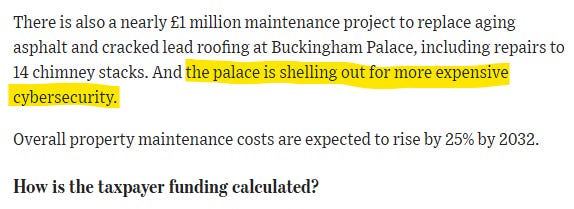
Keep in mind, the family holds vast wealth in non-reporting trusts housed in territories. Meaning, I’m here but I’m not here and you’ll pay the bill for my presence.

It’s a great picture, with a working fan shown to his right. The fan must be added digitally… it can’t be real. Evidently, it’s hot in London.
Hot is relative. I personally thrive in heat. While I can do without the direct midday sun rays, actual heat tolerance is my superpower.
Even world #1 ATP-ranked Jannik Sinner made sure to tell reporters, “It’s getting hotter and hotter” during his press conference where he used meteorological narratives to distract from the fact he struggled far more than expected to knock out 50th-ranked Serbian M. Kecmanovic in the first round. The match went a full five sets including a set three tie break which Sinner lost. He fought his way to the first-round win.
I’ve watched a lot of tennis over the past few years, in person. It’s a newish hobby for me, in midlife. I’m a decent player, getting better by the month, and fascinated by the intricacies of the game.
Seeing In Real Life Versus on a Screen
This year at the ATP Masters 1000 in Monte Carlo, I watched Sinner and Alcaraz in the Sunday final. For reference, I saw three entire days of men’s tennis including most of the top ten players for ~$1,300. To me, that’s as much action as you can possibly get.
Plus, it sure beats paying ~$10,000 for one session at Wimbledon, too much of which goes to covering the expenses of the All England Club members.
A former president of that club’s yappy son once bragged to me how his old man doesn’t even wear court shoes twice. Like, the locker room attendants lay out a fresh, new pair every time he plays. You can pay for that.
Sure, the tennis majors are best of five sets where the Masters 1000 Series is best of three. So, the real battle matches like Sinner v. Kecmanovic can run ~5hrs on the Wimbledon grass. But these larger events are a Kentucky Derby scene. Where too many of the attendees can’t distinguish Ad from Deuce sides of the court.
Let’s not get too far off track, or go too hard on the Brits. They’re already dealing with enough pressure, you know, the heat and all. The real issue here is the state of men’s tennis, which you can’t understand unless you see it up close and personal.
After Sinner beat Alcaraz in Monte Carlo, something looked way off.
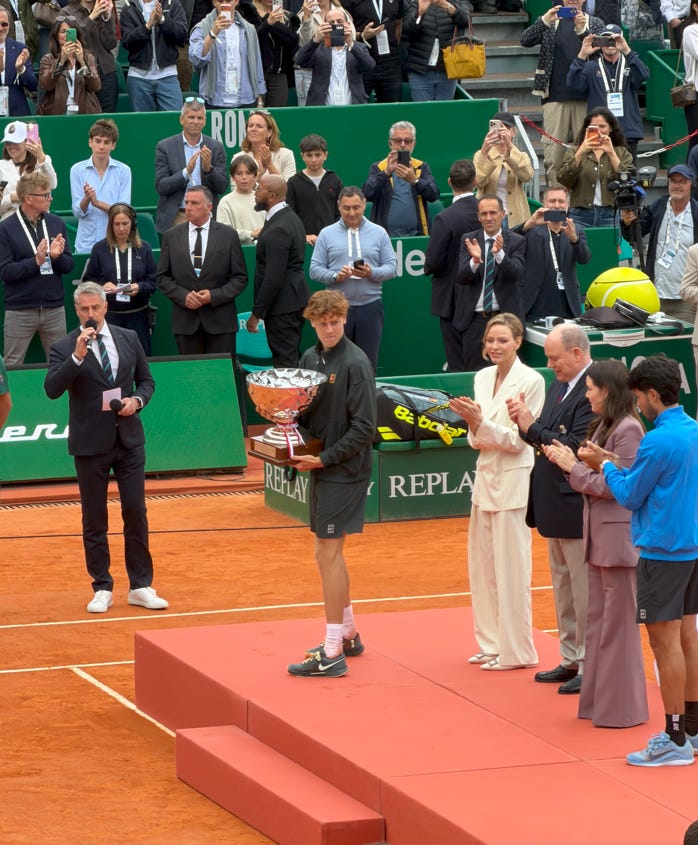
If you’re not paying much attention, this 24 and 23-year-old duo swept every title over a year or so.
They’re fun to watch, but couldn’t be more different. If they were cars, Sinner would be a Porsche, Alcaraz a Dodge Charger with an engine upgrade and superfluous spoiler bolted to the trunk.
When they played, Sinner would execute repetitive, precise shots, with almost boring accuracy. The Tucker kids know him as The Terminator, and have seen him play several times in real life.
Alcaraz played with brute force. He’s all brawn, no brain. Getting a tattoo after each major title to commemorate the win. Which is fine by free choice standards, but sort of goofy in practice. Notice the tip of an Eiffel Tower jutting out of his left sock in the picture above. That’s from the 2025 French Open win.
Then came the scene where his family fired legendary coach Juan Carlos Ferrero…who stepped in at age 15 and steered him through 24 ATP titles and six Grand Slams.
The rumor is, and let’s be delicate on rumors, but it’s been too believable to ignore, the 23-year-old became deeply unhappy with Ferrero’s rules and training protocols… like, if you want to win, you do nothing but focus. Example, Sinner.
Allegedly, and in keeping with Spanish cultural norms, Alcaraz’s family dispatched Ferrero at the end of 2025. He quickly won the Australian Open, then the wheels came off.
What I saw at the trophy presentation in Monte Carlo led me to think he left that event and punched something. When you earn ~$50 mil a year as a 23yr old who fires a top-tier world-class coach so you can “go to Ibiza with friends” and be 23… you’re running on brute force. This isn’t a game where that is enough to carry you.
So, let’s see what happens on the grass. Let’s see if my least favorite major star A. Zverev can win in a setting where there is no favored threat. Alcaraz has his hand in a sling, Sinner thinks climate change makes it hard to play, and Djokovic does breathe exercises during the changeover, because he’s almost 40. Let’s just see…
And since you’ll surely ask, my favorite player at this time is 25th-ranked Frenchman Arthur Rinderknech who serves like a Sandhill Crane and does this backwards cross court net volley you need to see at least once. He’s 6’5” so it looks like a ballet move. But it decicively ends points.
Yesterday Rinderknech dispatched with 22-year-old 6’8” American Martin Damm who’s built like a linebacker in straight sets. Damm has total career prize money <$1mil and might need the £120k he earned for losing just to get his team back to Florida. The hard-court season fires up in a few weeks.
Next, Rinderknech plays 39-year-old Novak Djokovic who’s gunning for his 25th major title and with Alcaraz out and Sinner wobbly due to climate change or something else he doesn’t want to admit, this might be the chance he’s been waiting for. At this time, Djokovic seems most likely to take it. But it’s still very early.
Tennis never stops. Which is nice, because my brain doesn’t either.
Let’s get into the portfolio now. One of our stocks got cheap on Tuesday. We should be excited. Second chances don’t come around often enough…