
Apostrophe City
The greatest funding trade of all time

Officially, there are no English words that start with an apostrophe.
You might hear someone tell their child, ‘cause I said so. Or, reference a lesser group as ‘em people, but these are merely dropping consonants out of convenience. Slang is more about vocal laziness than creativity.
Highbrow people warn against this kind of thing. They might be right. If you’re in a down-market kind of place at the wrong hour and figure out that you are in this case ‘em people, you might be in for a rough evening.
It’s an American thing. The whole apostrophe to denote conversational laziness. In other parts of the world, it means just the opposite.
Substance Over Convenience
The American way is different with a lot of things. Like the continental breakfast. Which is pretty much salted cardboard soaked in seed oils. Whereas in Europe, even the common hotel chains put out a respectable spread. There, people demand it.
It’s not like things are better in Europe. Big broad statements like that often get you in trouble. Intellectually at least.
The U.S. has a real meritocracy. The barrier to moving up or down class ranks is low. People regularly make and lose generational fortunes on American soil. Anything is possible. It might be why people take gargantuan risks trying to make things happen. Some do…
It’s not the case in Europe. While you’re free to move down the class ladder as quickly as you choose, moving up is a different story. Practically speaking, it’s not possible. People often say about European culture, you know your friend group for life by the age of 5.
It might be why things feel older there, more established. Maybe we have no choice here but to build aluminum-framed structures like a Hollywood set. We might be living a whole other life by the time they need repair. If we had to stick around for a thousand years, maybe we’d see it differently.
Like Duke Henry I of Brabant. Dutch guy. He wasn’t even part of the Dutch monarchy. Just a rogue limb on the family tree.
The Duke did the wise thing and married into the English monarchy. He angled for King Stephen’s granddaughter. We’re back in the 12th century here. And we’re talking about scooping up a maternal granddaughter of an already dead former king.
That couple then married off a daughter to King Otto IV of Germany which gave the Duke an in with his eastern neighbors too. Keep in mind, he otherwise had no real power.
First wife died, and he went with King Philip II of France’s daughter next. This guy had an alliance with basically every territorial neighbor. He kept this up and really made it up the noble ranks.
Let’s not get too far into the historical gossip column to miss the point here. The Duke needed social activities to entertain these visiting foreign monarchs. Nothing shabby either… when you need to climb, optics matter.
So, he had a little hunting village about an hour south of Amsterdam. It’s still there today. Not just standing, it’s rock solid.
The name is ‘s-Hertogenbosch. Colloquially, “Den Bosch.” The literal translation is, “the Duke’s forest.”
The Herd Misses the Point
Last week, I went to the Duke’s forest. But not to hunt, or study history.
It’s part of an ongoing frustration with state of spectating. More broadly, with how people spend the money they’re so obsessed with getting.
This isn’t about dos and don’ts. People have the right to do whatever they want with the funds they sacrificed something to get. There’s always a sacrifice in any pursuit… The real crime is they seem more concerned with impressing others with how they spend it.
Meaning, people often want you to think their spending is cool. They want you to see and like the Instagram post. More than that, they want you to wish you were them. Somehow that makes them feel good, or at least better.
But it’s meaningless. For instance, you can buy a ticket for the Wimbledon finals on July 12 for ~$17,400. That’s sort of middle-rung, solid viewing. People on Instagram will be impressed.
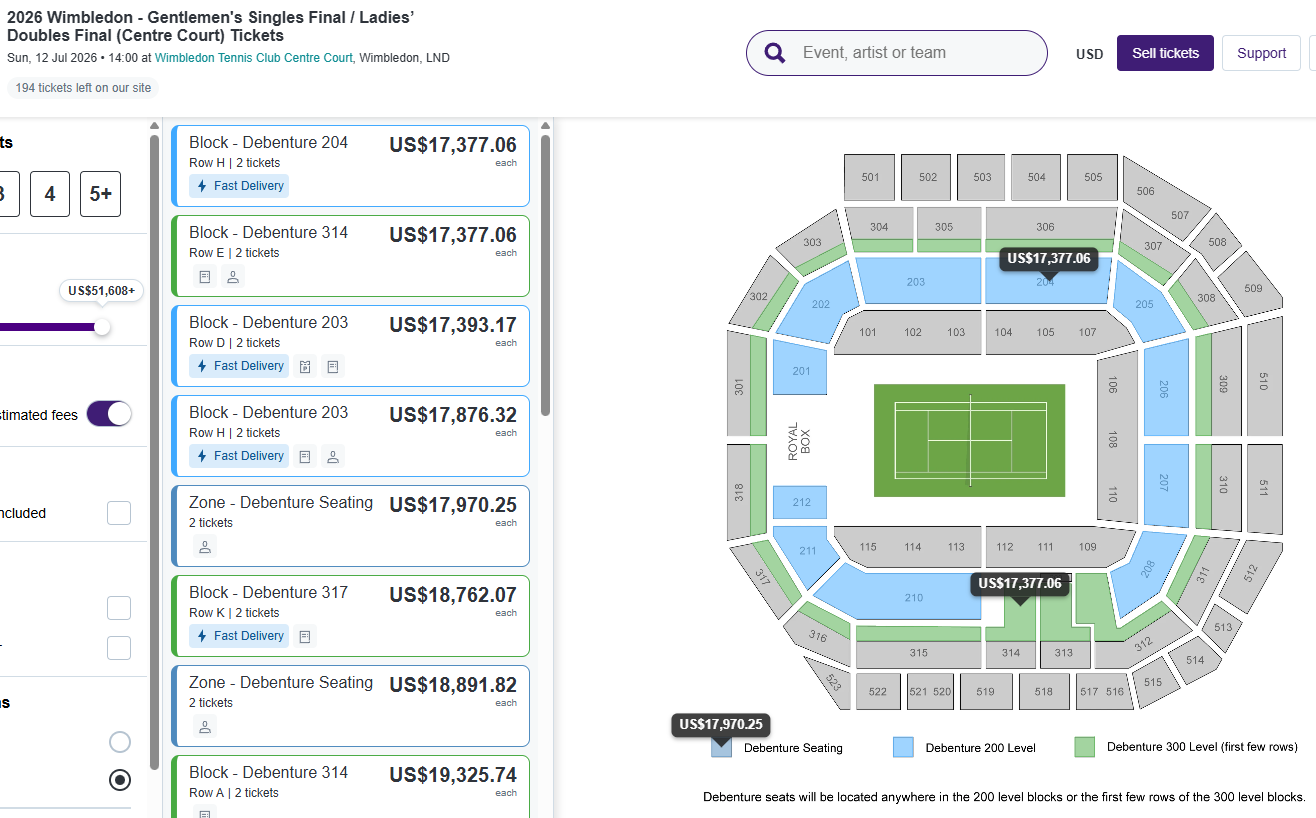
There are a lot of problems with this… for starters, much of the audience won’t be able to identify the deuce side from the ad side of the court. They’re using the zoom function on their phone to locate Beyonce after she appeared on the jumbotron.
You pay ~$17.4k and you have the right to do whatever you choose, even scroll socials while French Open titlist A. Zverev battles internal darkness against someone whose identity we don’t know yet.
The French Open is the apex of the clay season. Tennis has surface seasons within the total season. Clay runs from early April through the French Open, roughly two months. There are four rogue 250-point clay events in Europe after Wimbledon but nobody really knows why.
250-points is what the titlist receives, and why he/she plays. It’s not the money, without points, you’re doomed. More points means better seeding in the next tournament. Better seeding means easier early round matches. And the wheel keeps turning. The tennis season basically never ends.
The French Open is one of four 2000-point tournaments. It’s the only clay major, capping the clay season. Wimbledon is the only grass major, capping the grass season.
The grass season is short, about 6 weeks. Playing on grass is wholly different from clay. You slide on clay, it’s elegant. Drop shots are the kill weapon.
Grass plays differently. The ball bounce height notably. Kick serves (where the ball “kicks” high after bouncing) don’t work well. It’s a fun surface, and the most traditional… but it’s different.
To transition from clay to grass, which players must do in roughly one day since the French ends on a Sunday and grass starts on Monday, they’ll play smaller 250-point events.
There are two options for transitioning quickly to grass. Which means being physically ready for Wimbledon. The Boss Open in Stuttgart, DE. Or, the Libema Open in ‘s-Hertogenbosch, NL.
Into The Duke’s Forest
It’s hard to get excited about going to Stuttgart. Feels more like somewhere you’d be sent.
‘s-Hertogenbosch on the other hand, is a treat.
Don’t think the Libema Open, an ATP 250-point event, the first grass event on the calendar, is some no-name exhibition.
Three top-ten players were in the draw this year (Auger-Aliassime, de Minaur, and Medvedev), plus known grass masters like Mannarino, and 24th-ranked 6’5” Arthur Rinderknech who literally moves like a bazooka-wielding butterfly.
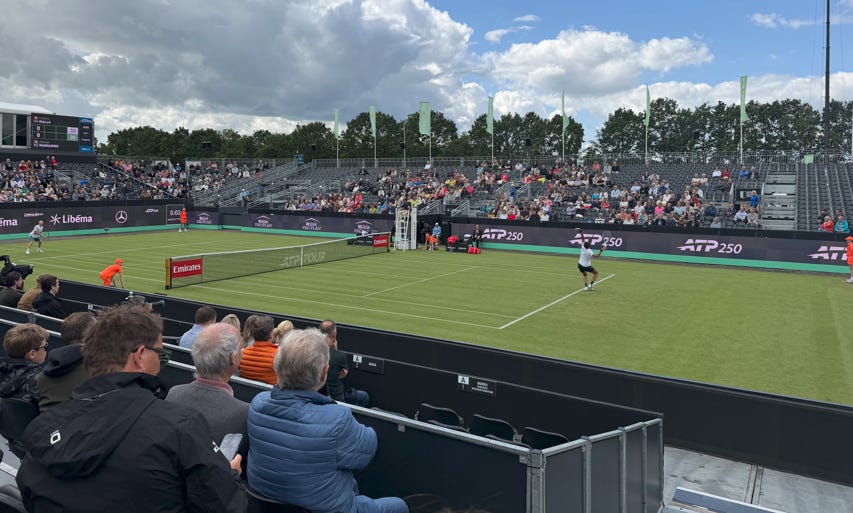
You can watch all this action for €100/day (USD$116). Plus, the concessions are elite. There’s a full espresso coffee station, Indonesian satay, salads, “duck burgers” which are confit duck sandwiches really.
Before and after the action, you’re in town. The Duke’s forest is no backward village. It’s more of a medieval city that evolved with the times.
The Netherlands is generally wet, with canals winding through most towns. In this one, it’s more like a floating art gallery.


That’s just the visual side of things. There’s a hotel inside a working crane. Or a more traditional canal-side boutique hotel just opened in May in a building that predates the U.S. Civil War.
The town has its own unique pastry called the Bossche bol. It’s a layered dough shell, like croissant dough, filled with light cream, then dipped into liquid chocolate. It might look heavy, surprisingly, it’s not. The Dutch aren’t known for bulging waistlines.
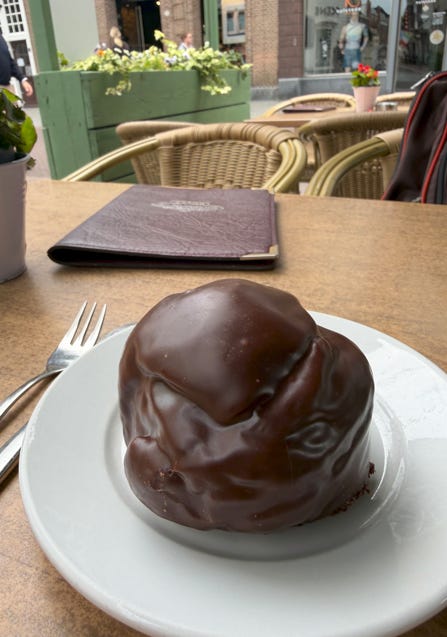
Obviously, there’s specialty coffee available.
When it comes to regular dining, the Noble Gastro House was so good I went back a second night to work through the rest of the items I wanted night one. Its business card says, “Happiness is enjoying food and more.” Still unsure what the more is, but openminded on it. The owner is in the kitchen, his son seats you, and their menu absolutely does not miss.
After dinner there’s a bizarre levee crossing where you hand-crank a raft then traverse a huge wetland nature preserve, ending up back in the ~1,000-year old town. What a place…
No Time for Learning
We don’t have enough space to get into everything worth seeing in ‘s-Hertogenbosch. After all, this is a financial newsletter, not a travel magazine.
Two types of people read TTL. The first is transient. They’re just convinced there’s a secret stock symbol. They need it. They’ll take a free trial to get it. They’ll invest about six minutes scrolling around looking for it. Then get distracted on Twitter looking at short video clips of dogs eating ice cream.
The other type realizes the importance of thirty minutes invested in learning for the sake of it. Knowledge is not a museum-grade one-off. It’s cumulative.
It means the more you learn, the less instruction you need. The more you see, the more clearly you see everything. In time, you don’t need advice, you need inputs, stimuli.
The average person these days runs on corn syrup. Quick hit, hard crash. You, on the other hand, know where to get the dense protein.
The last issue of TTL was Buy, Borrow, Die. It’s more than just a kitschy story in a newsletter. It’s a modern American concept. Critical to see if you want to understand the why behind how things move.
As a culture, we don’t really own anything we plan to use anymore. We merely borrow against it knowing it’ll rise in value making the loan a rounding error.
This concept is a lot like the 2000s. People bought one of those earth-tone tract homes in a treeless subdivision east of the freeway. They took a mortgage, and about a year later, took a second mortgage.
The first one paid for the property. The second one paid for vacations, braces, and tuition to one of those online colleges nobody finishes.
When they sold the property, all the consumption washed clean. That was the plan at least.
People do the same thing with stocks. By people, we mean nearly the entire top shelf of the Bloomberg Billionaire Index. They don’t sell; they borrow.
Not The Top
Someday, we’ll have a multi-year period where stocks go nowhere, or worse.
Not necessarily a crash either. That was more of a thing in capitalism. When you needed actual money to buy assets. The setup is a little different now. Downturns are more of a morass where things go nowhere.
Think about it like the real estate market since 2022. It’s done nothing. Sure, there are pockets, but overall, dead.
Real estate falls apart at a rate of ~2-3% per year. If valuations go nowhere, people start counting pennies. Eventually, hairdressers go back to only cutting hair, unable to justify the cost of their dormant state real estate license.
That’s a good indicator by the way… the hairdresser real estate agent indicator. You won’t find it in a newsletter trading system, only by reading seemingly unrelated stories. If you have time…
It’s time well spent. You start seeing things differently in the market. They even feel obvious. Like the evolution of Buy, Borrow, Die behavior. Financial elites no longer need cash-flowing assets. They need narrative engines powerful enough to collateralize indefinitely.
The stock market of the 20th century wouldn’t have liked Space Exploration Technologies Corp (SPCX). Not at the IPO price of $135. Not at the day one close of $160.95, or Tuesday’s high of ~$225.
Bloomberg pulled out every dinosaur analyst from prior eras to point out the company had aggressive assumptions, fuzzy details, and no shareholder voting authority. Doesn’t matter…
None of it matters. The stock might go up more, or down some, and you can guarantee there’ll be a shelf filed with a robust at the market equity issuance facility. Don’t even bother asking Investopedia what all that means, the details matter less than ever.
By the way, Fidelity offered clients IPO shares through indication of interest. Most people got filled on some or all of their request. They urged filled accounts to not sell for a month or so. Threatening them with future access to IPOs.
That was $135 running to ~$225 within days. You can guarantee the bankers working OpenAI and Anthropic, and others saw this. They’ll try to copy it. If you have a Fidelity account, maybe you’ll feed the beast later this year. It’s hungry.
Time will tell if the SPCX major holders sell stock. They likely won’t, in any serious quantity. More likely, they’ll borrow against it, using the proceeds to do whatever it is they want to do, maybe buy more assets, and borrow against those.
This all has the potential to make the big beast even bigger. Instead of a crash, it might send even more money chasing even less quality. We should pay attention.
Change Your Perspective
In your desperate scramble to find the next life-changing ticker symbol, try to remember there’s only so much sand in your hourglass.
The trick to making money in the modern market is less about one exclusive stock, and more about noticing the obvious. It’s the money equivalent of people who are so glued to their phone screen they barely know where they are.
Instead of tipping your way into the Mayfair Cipriani after spending $17.4k to see someone other than A. Zverev win Wimbledon, zoom out for a minute. You can see world-class tennis and eat unforgettable food in many places. Most of them at a fraction of the price, and without the attitude.
It gets you back to the big question of how you’ll spend finite time. Other people won’t remember what you did, you will. Your final lucid thoughts likely won’t be about what those other people thought of you.
Let’s not lose sight of the point here. TTL is a pro-money publication. We’re about better watch movements, finer cuts, and things that make life more fun. The difference is in the way we do it.
Just listen to how people talk. They truly believe they’ll use bad habits and unexamined thinking to get to some place other than where they are now. Once at that place, which they can’t usually define, they’ll start enjoying themselves. That never happens.
When you let go of that, things look different. People spout platitudes about how every day is a gift. It’s not really true, there are no gifts. You’re here, get on with it. One day you won’t be here. You won’t be able to try a Bossche bol. Or, you won’t have working teeth and merely smelling it will drive you nuts with regret.
Get on with it. Find a hobby, spend some money getting into it. I mean, get into it, man, go see the 250-point tournament where A. Mannarino bends over and has some completely odd conversation with himself facing the grass… just weird. Go see that.
What you’ll find is, the world starts to look different. Things look more obvious. Decisions become instinctual.
Getting It Right
That’s your personal journey… I’ve volunteered to share mine with a large audience which is not always wise, but that’s my path.
The fundamental analysts upset about SPCX don’t get it. We value different things now. Bean-counting was a capitalist thing. Today, we assign value to narrative, momentum, and big thinking. They miss that.
It’s the thinking that matters more than the details. In 2020, I wrote a simple book about gold. Normally a boring subject, an 8th grader could finish that book and generally know how gold works.
Fundamental thinkers in the gold world didn’t like the book. More accurately, they had pedantic complaints. This or that was slightly different from some microscopic detail they spent decades worried about.
Yet gold went on to roughly quadruple from the 23 days it took to write the draft in April 2020 to its high Q1 2026. While I can’t know with certainty, I suspect most of the gold pundits failed to make profits real.
I’m in a large WhatsApp group chat with mining-related people and can tell you the ideological agreement is so heavy I had to permanently mute it.
There’s something wrong if you can’t make money from a big, lumpy, boring asset that quadruples.
Gold has a value of ~$32 trillion at current prices. That’s all the known, mined, hoarded gold in the world. It’s a lot… it’s plenty, for now. The odds of gold doubling again this decade is low. If it does, Katy bar the door. That would make it worth more than the entire U.S. public equity market and the U.S. Treasury market combined. It’s just too much.
Meanwhile, the value of all Bitcoin (XBT) is only ~$1.3 trillion. Gold grows modestly with annual production. Bitcoin has a mathematically capped supply.
There’s no reason why XBT can’t triple in value. That’s still only ~$5 trillion worth. SPCX had a value of half that yesterday afternoon. And they can print as many shares as needed, anytime. Plus, one person has ~86% voting power over it. XBT is mathmatically liberated.
Further, the average American plebe has no clue how digitally screwed they are. They’re already tracked, traced, filmed, verified, monitored from the fridge to the bathroom. They seem to love it. Soon, they won’t be able to buy a piece of candy without their government knowing about it.
You start to wonder how they can’t see it. It seems so obvious. The world is going full digital. They might see it as their only viable life raft. If that’s how things unfold, they’d scramble like a stampede of panicked cattle trying to get some.
Like gold in 2020, XBT feels like something we’ll look back on at the end of the decade and wonder how we didn’t see it. I mean, we’re talking about it right here, right now. But talking and acting are two different things.
How Seeing Turns to Action
I read all of your comments after each issue. Usually making two passes through the comment section. Once maybe Friday, and again on the weekend. It depends on how much I’m being bothered by other tasks.
Subscriber Lehel sent this comment directly to us after the last issue. Remember, irate former subscriber Stephen M. felt slighted he didn’t receive personalized signals on when exactly to act on a stock we recommended then wrote about at least five times… which went down a little bit with the overall market, then up ~150%.
Lehel, consummate TTL reader, and thoughtful communicator, sent this follow-up question, which we suspect many of you have at some point also pondered:
“If YOU don’t own any now, would you consider buying some considering your original thoughts... I am interested in what you would do with your money in this case... a friendly suggestion may be that you increase the frequency of general contact with subscribers to offer more relevant context...”
Let’s translate this friendly suggestion out of polite corporate speak, and into reality.
What Lehel actually wants is a direct instruction pinged at 1016hrs via electronic device to ACT NOW because this will absolve him of any responsibility for a bad outcome. Any good outcome will be his to keep. This is not personal Lehel, it’s common, but it’s a recipe for disaster.
The stock Stephen M. didn’t buy went up ~150%. We wrote it up in late January; it fell over the course of ~3-4 TTL issues. We updated our thoughts in TTL issues, and it worked out. A long-haul truck driver could have bought it using an out-of-hours market order placed from an overnight stop at a Buc-ee’s…and still captured some portion of that ~150% return.
The Trust bought it at ~$55 after the waiting period, added to it in the high ~$30s, and sits on only a ~58% gain now, less than half of the maximum possible gain low to high during the time we’ve covered it. And, we’re happy with it. The first and last tick of a trade are too dangerous to chase.
That said, the question is a chance to go deeper. This is a marathon, not a sprint. Money decisions are ongoing, constant over a long life.
Practically Speaking, Lehel
As an example, if I owned zero gold, like never seen an ounce, I would buy some. I am not bullish on gold. In fact, I am sort of negative on gold. Yet, if I had zero, I would put a small % of assets into it and plan to add more down the road when it was broadly overlooked.
If I owned zero Bitcoin (XBT) I would stop reading this newsletter and figure out how to buy some before I finished this cup of coffee. I’d decide between a low-cost ETF like the Morgan Stanley Bitcoin Trust (MSBT) which hit the market at a record low fee of ~14bps/yr.
Or, Fidelity Crypto which offers 24/7/365 market access and charges no management fee (does charge a hefty commission of 100bps). Since I’d likely buy it dozens of times to build a position, sit on the position until the plebes figure out how utterly screwed they are digitally speaking, the buy commission would seem modest.
Another option would be to buy it on a USB stick and bury it behind a rental property, which people do, but I wouldn’t.
And the stock Lehel really wants to know about is one of three cybersecurity companies we own. Two ripped back into an anabolic uptrend. The third did not. I’d be flat out panicked if I didn’t own any of the first two. The laggard… I’d wait for an uptick.
Let’s look at all three charts to see why.