
AI Changes Nothing
There will be winners, might as well be you

A “Berry Man” was the pinnacle of success in the 1970s.
It’s the name given to a corporate army under the command Loren “L.M.” Berry, the king of Yellow Pages advertising sales.
Barry’s sales team dressed better than their customers, drove nicer cars, and earned more money. Around ~$200,000/yr at the time which is about $1 million today.
Loren Berry created a culture by example. His early life shaped him. Born in 1888 in Wabash, Indiana, his father died when he was just four years old. His widowed mother sold horseradish to survive. Horseradish…
She trained Loren to take over horseradish sales at age eight so she could be a nurse, and a midwife. Her son went on to sell advertisements on printed local directory fliers. This was the Google search of the early 1900s and 10s.
He never stopped selling. He pitched people in carriages, hotel lobbies, weddings, funerals, churches. He made it a disciplined lifestyle and demanded the same from his army of salesmen.
It worked. Berry’s intense focus and determination culminated in ~1 million advertising customers across ~800 local telephone directories with ~$300 million in revenue before selling out to Bell South in the 1980s, after his death.
No More Yellow Pages
Nobody under the age of 40 knows what the Yellow Pages is. The brand still exists online, but it’s practically irrelevant.
Plus, the whole culture Berry demanded isn’t relevant anymore. Cadillacs are plastic clunkers, nobody wears suits, and the whole work hard mantra might be a thing of the past.
Influencers are the new “ad men.” They can sleep late, and make videos about how tired they are. Millions of people watch them. They turn that eyeball time into cash.
Things change… and successful people change with them.
The problem is, most people panic at the idea of change. They worry they’ll lose something they have. They forget how much opportunity change brings with it.
Especially when entrenched success resists change. This means the most successful people who dominated yesterday tend to grip what they have so intensely they can’t see new, larger opportunities.
The wise Berry Man of the 1970s and 1980s switched to software sales in the 1990s, medical device sales in the 2000s, and something else today, maybe influencing.
Most of the time, change doesn’t have to be dramatic. Things start to shift. Instead of gripping on in fear, try to notice the shift. Accept it, and go with it.
Spotting The Next Big Thing
Earlier this week a viral article ripped through the market psyche. It caused a radical sell-off in many tech stocks, unfortunately in one we own.
If you read the article, you know it’s dystopian fiction set in 2028. There’s talk of former tech executives scrambling for work on hyper-optimized food delivery apps, doing handy work, and overall resigned to subsistence living.
It goes on to expose agentic AI as an optimization tool that never sleeps. It optimizes us out of existence. Which flattens government income tax revenue, and the value of almost every tasks.
While the author says the broad stock collapse after publishing was a big surprise to him, we’re skeptical.
After all, we did roughly the same thing in TTL back in June 2023. It caused no sell-off, did not go viral, and most of you had nothing to say about it.
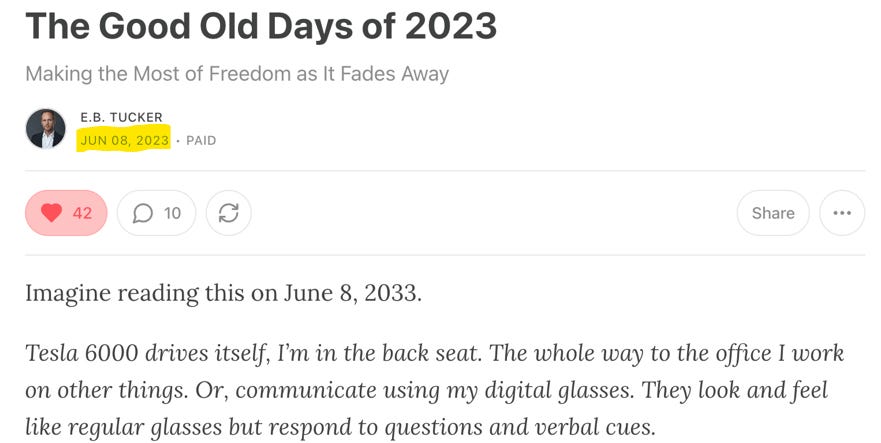
That’s OK… we know things that are urgent get the more attention. Something new will hijack attention tomorrow.
Agentic AI will likely not cause a dystopian era where former tech executives mow lawns to survive. Partly because they don’t know how to operate gas-powered lawn equipment. Also because in that scenario there wouldn’t be many people with sprawling, manicured yards which come with great expense for the owner.
The swift sell-off this week flushed anyone who over-borrowed to buy shares in affected firms. Just a few days earlier, in the Feb 12 TTL issue, we printed this after the portfolio table. It’s part of a larger statement you might want to revisit.
Generally, you should be aware AI may eliminate most repetitive employment tasks. Think of this like being a woodworker at the advent of mass-produced lumber products like factory-made doors and windows. Retire your chisel and get a different job.
This is what the successful viral hit piece did to some larger stocks earlier this week. We don’t own these three, but it’s a fair representation of what happened to a big chunk of the market… in a matter of minutes.
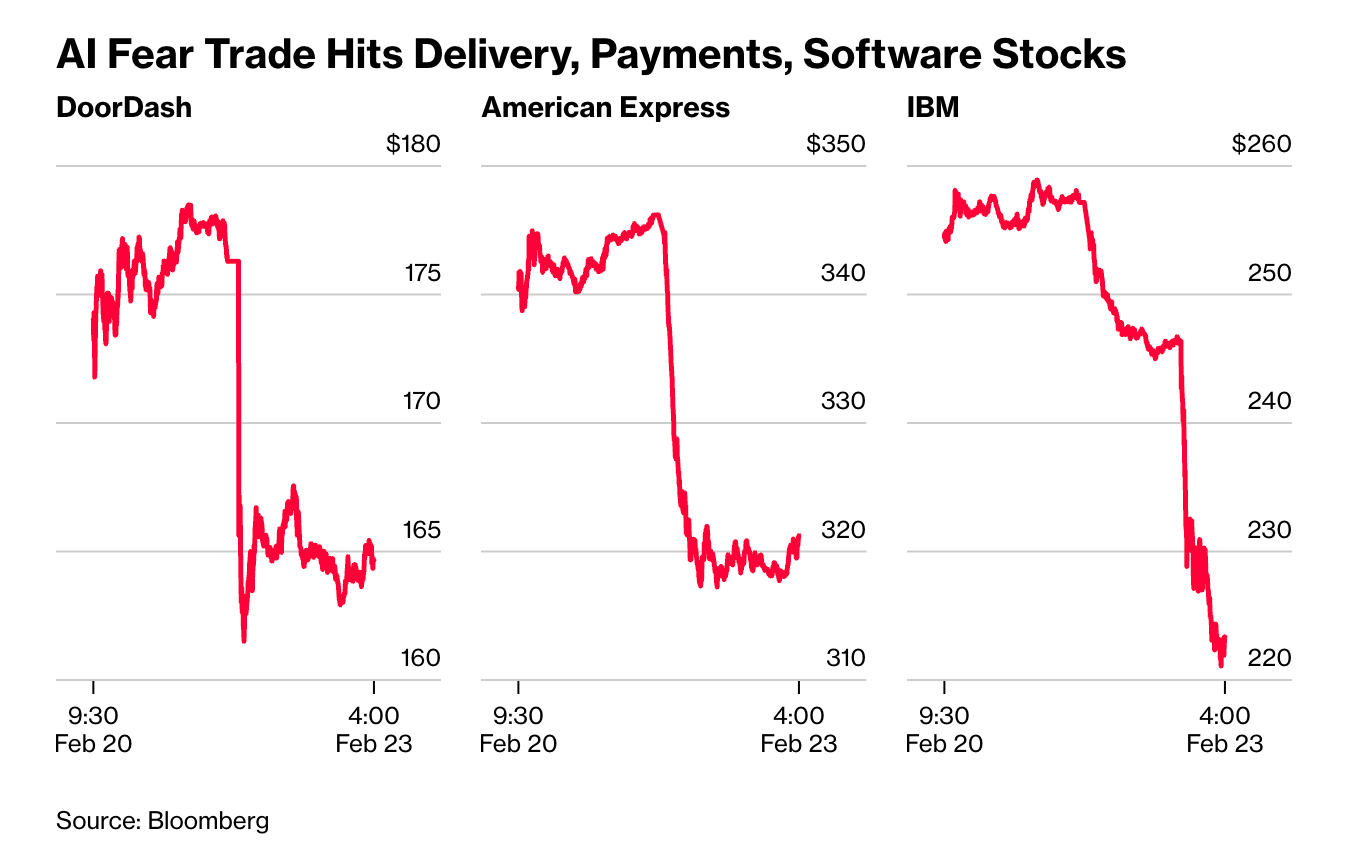
~25% Smaller in ~90 Minutes
It’s tough to lean on predictions like the ones made in that Citrini hit piece. For starters, there’s no portfolio of ideas displayed. It’s merely a macroeconomic thought piece.
The comment section at the end of the article is highly valuable. There are many tech executives relaying specific insight about big, glossy statements in the piece.
Not everything goes pancake in an era of big changes. Some companies evolve into players for the next era. Amazon started as a book retailer. It used change as an opportunity to grow.
IBM did the opposite. It went from corporate titan to bureaucratic morass. Its executives ignored external change, focusing instead on protecting their place inside the corporation. In real terms, IBM shrank at the dawn of the personal computing age.
Static predictions are rarely accurate. They miss how things evolve as people steer companies through change. That’s what makes change a dynamic opportunity.
As for our top-tier cybersecurity stocks in the Trustee Portfolio, it’s hard to see a future without them.
Life is moving fully digital. Try living analog for a month if you’re slow to believe and accept this. You can’t access anything without a digitized portal.
Last week’s news was an agentic AI tool called Claude would provide low-cost, easy cybersecurity, commoditizing the service.
What many missed was a simultaneous report from Amazon on hackers using Claude to radically enhance their effectiveness.
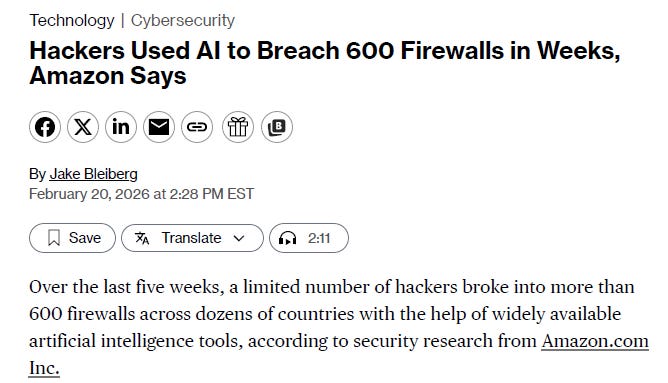
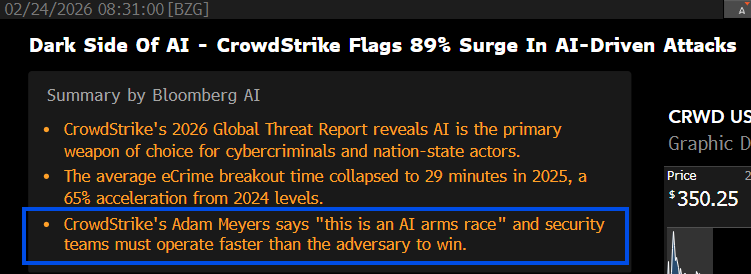
Claude will help protect you, and help the hackers target you. Evidently…
The pace of news flow fails to see the full picture today. Our system relies on ownership. We own things, we want them to go up in value. Companies own things, boards of directors supervise ownership on behalf of shareholders. We doubt they’ll easily turn that over to Claude or any other low-cost agent.
A Marathon, Not a Sprint
The Trustee Portfolio has sixteen stocks split between two sections. One is more core. The other more transient.
From the pulse of the recent feedback, nobody seems to own the core stocks.
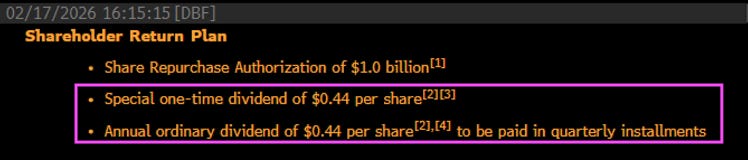
The large concrete company we suggested in the February 12 issue might soon decide to start paying a dividend… did that last week sending the stock up ~20% YTD.
Or, the large American tractor company which shockingly, sold more tractors, boosting its outlook, and notching a ~35% YTD gain.
Or, the world’s finest maker of tennis racquets, a family-controlled business up ~12% YTD and ~59% since our recommendation ten months ago.
Ten months… not even a year. Which as a reminder, is a key distinction for individual stock investors. The general obsession with instantaneous wealth misses the facts of taxation.
The goal here is to beat the index, by a nice margin, year after year, for decades. There will be lumps… but this is a marathon, not a sprint.
And the chosen cadence is a firm base (the core) to make taking risk more palatable.
We’re adding two new stocks today. One might be a key figure in the “Future Fed” which could administer a FedCoin to cinch up this whole digital era once and for all. The other is a muscle play on the same movement.
There’s a common request for specific instruction with how to use the portfolio. We don’t do it, because we can’t. The “give me the ticker and tell me what to do” impulse might be tempting, but it’s dangerous.
Try to read the issue and understand why we like something. Then decide where it fits in your holdings.
Successful investors make a habit of constantly learning. Compulsively learning… even when the thing learned doesn’t go into practice right away.
What novices miss is, the more you expand your knowledge base, the easier it is to spot opportunity.
Like the obvious intermission between acts of our monetary system.
Prepping For FedCoin
Chapter 17 of Why Gold? Why Now? laid out a case for FedCoin as an inescapable currency system that seemed inevitable. What we see now is the entire Fed might vanish in the process.
It’s easy to imagine the shrills like that lady senator who’s always barking at money people, calling for a full Fed inquiry. They’d love to “end the Fed” after it’s already over.
Sort of like all these files from the 1990s clogging up the WSJ homepage the past few months. If you know about stuff, then you already knew about all of this. Like, a long time ago. But most people have no clue. They wait to be told what to think.

The thing with the Fed is it’s an old tool. It mattered when lending and banking was a spigot for the capitalist system. That’s less and less the case.
A new Fed 2.0 might be made up of stablecoin issuers. These companies have a somewhat divine business model. People give them official U.S. currency; they exchange that for digital tokens. So far, the customers rarely ask for the money back.
Meanwhile, the stablecoin issuer uses the money to purchase any number of hopefully appreciating assets. The largest of these issuers has ~$184 billion of customer funds to invest. It’s sort of like a modern-day life insurance float situation, where they had almost free use of funds until people died. This is a bit better as even customer death might not lead to a call for repayment.
Shareholders of these money alchemists might later look like the modern equivalent of early 20th century bank investors. That’s back when the bank had real power. Stroll over to a retail branch of a name brand bank today and assess the current situation for yourself. It’s on par with paying a utility bill downtown at the county building.
Several of these potential pillars of the new system are private. Buying them is tough. Not impossible, just complicated. The second largest is public, and looks like it found its post-IPO footing.